Our main method of practice in the dojo is through the beginners' observation and duplication of the instructor's technique. The instructor then makes corrections to the students' movements. After some time, the student is shown more complex two-person kata that allow him or her to string several basic techniques together. In this way, we gain confidence in our skill and ability to control our training partners.
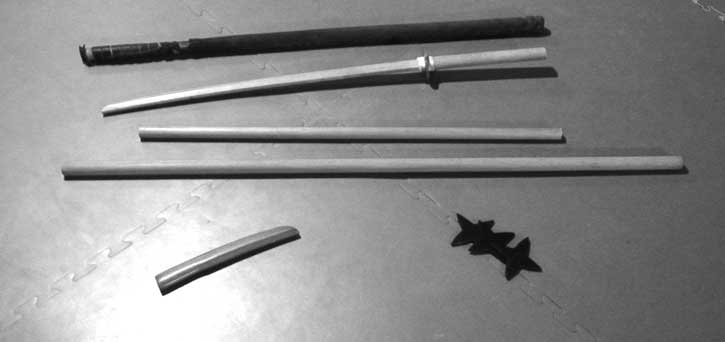 We teach the three primary weapons of traditional Japanese arts:
Kenjutsu (Japanese sword) utilizing the katana and kodachi (long and short Japanese swords)
Bojutsu (stick fighting) with the rokushakubo (6-foot staff), jo (4-5 foot staff) and hanbo (3-foot staff)
Shurikenjutsu (throwing blades)
The goal of our training is to develop each student's ability and to pass along the Bujinkan arts to future practitioners. Through skill in taijutsu, the individual learns to control not only their body, but also their mind in order to transcend any barriers, physical or emotional that the student may encounter. The result is a person of compassion and strength responsible to himself and the community. Soke (grandmaster) Hatsumi describes this state as tatsujin (a complete person).
History of the Bujinkan Dojo
The fighting arts of Japan are over 1000 years old. For several centuries, the country was in an almost continual state of civil war. The warriors of this time developed methods of hand to hand combat that were unequaled by any society. These martial arts were tested on the battlefields of ancient Japan and only those techniques which were proven to work survived. Unfortunately, when Japan entered into the modern world, much of these mostly secret methods were lost through disuse and neglect. In their place the modern "martial" sports of Japan (karate, judo, kendo - which have their basis in the fighting arts, but have been modified over the years for safety and ease of practice) have come to be more widely known. Today, only a handful of the tried-and-true bujutsu (warrior methods) have survived intact. Passed along from teacher to student over many generations, these shinken gata (real combat methods) are practiced by a relative minority of martial artists.Masaaki Hatsumi grew up learning the traditional martial sports of his country. Mastering karate, judo and aikido he found these arts to be lacking when facing bigger, stronger or faster opponents. Hatsumi searched for years for an art he could believe in until one day he was introduced to a bujutsu master named Toshitsugu Takamatsu. Having mastered several traditional Japanese arts by his teen years, Takamatsu had traveled throughout China and Mongolia in his early adult years, testing and improving his skill in the Japanese martial arts he had learned from his teachers until his return to Japan where, in addition to his martial pursuits, Takamatsu also devoted himself to the study of Buddhism. Hatsumi was in awe of the ease with which Takamatsu defeated his opponents and inflicted pain on attackers. Hatsumi made frequent trips across Japan throughout the 1950's and 60's to train under Takamatsu. In 1972, Takamatsu sensei passed away and bequeathed the title of soke (grandmaster) in nine schools of fighting arts (including the last two historically traceable ninjutsu traditions) to Hatsumi.
Hatsumi Soke opened the nine traditions - which he called the Bujinkan Dojo (Divine Warrior School) - to the public in the mid 1970s and the art of ninjutsu began to be practiced throughout the world. Hatsumi sensei has been recognized by the Japanese government for his efforts to pass on the traditional martial arts of Japan. There are now hundreds of schools and training groups teaching the Bujinkan arts scattered about the globe. In 2020, at the age of 88, Hatsumi sensei retired from actively teaching and has named successors who will keep the nine ryuha of the Bujinkan alive.
Instructor
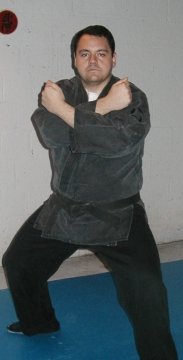 Don Houle shihan is the instructor at the Bujinkan Happo Dojo. He began his training in 1986 while living in Massachusetts.
In the 38 years since, he has travelled across the US and the world to train with Hatsumi sensei and many
other senior Bujinkan instructors. After relocating to New Jersey in 1994, Don was accepted as a student
at the Bujinkan New York Dojo. In order to train more often,
he began a small training group at Rutgers University in 1995.
Don Houle shihan is the instructor at the Bujinkan Happo Dojo. He began his training in 1986 while living in Massachusetts.
In the 38 years since, he has travelled across the US and the world to train with Hatsumi sensei and many
other senior Bujinkan instructors. After relocating to New Jersey in 1994, Don was accepted as a student
at the Bujinkan New York Dojo. In order to train more often,
he began a small training group at Rutgers University in 1995.
Don made his first trip to Japan to train with Soke Hatsumi in January 1997 and in 2003, he passed the godan test (5th degree black belt). April 2004 saw the founding of the Bujinkan Happo Dojo. Don continues his studies by traveling to Japan to study with the Japanese master teachers.